Music and Beyond: Satoshi Yoshihara
It almost feels strange to me that I now spend every day with an instrument, because as a child, I had absolutely no interest in music. At age three, even when handed castanets, I wouldn’t so much as tap them. In kindergarten, I was the only child who stubbornly refused to play the melodica. My parents listened to music quite a bit, but I think I just couldn’t accept the idea of producing the exact sounds that were expected.
That changed in the fall of my first year of junior high, when I happened to catch a TV program titled Introduction to Guitar. The moment I heard the guitar, something just clicked. To this day, I can’t explain why. But from that day forward, I began playing the guitar every day as if possessed. That was the beginning of my life with the instrument.
Over time, my interest expanded to all kinds of instruments. It wasn’t just that I wanted to hear them; I wanted to touch them. I wanted to recreate those sounds myself. Since I didn’t have a drum kit back then, I’d use the drum sounds on a keyboard, record them onto a cassette, and then layer the bass and guitar on top. I was teaching myself music theory while experimenting with multi-track recording all on my own.

I first encountered the banjo in high school. A graduate of the school who was six years older than me was a professional banjo player, and he used to practice out in the schoolyard. The sound was loud and distinctive; I thought, “If I play this, I’ll definitely stand out!” So, I asked him to teach me.
My path became clear during my third year of high school. While studying abroad and experiencing real American music firsthand, I knew I would make a career in music. I went on to Berklee College of Music in Boston, where I did nothing but play—my days were entirely consumed by music.
I wasn’t fully conscious of it at the time, but I’ve always been drawn to chords. I simply feel happy when I play them. Chords offer harmony, rhythm, and melody all at once. I think that’s why, of all the instruments I’ve explored, the guitar and banjo became my primary tools of expression.

At college, the group I practiced with included an Italian drummer, an Israeli bassist, and an American keyboardist. Playing in a band with such diverse peers taught me the joy of “musical chemistry”—the thrill of communicating through sound.
I feel there’s a strong connection between language and music. In jazz, especially, everything is improvised, making it like a real conversation. You aren’t just tracing a score; you are expressing the melody you want to express in that moment. It’s no different from talking—you’re simply using an instrument instead of your voice.
My curiosity often leads me down unexpected paths; for a while, I was deep into programming, which eventually evolved into a fascination with linguistics. These days, I’m exploring Hebrew, Korean, and Cantonese. Even my phone is set to Spanish, the language of the guitar’s homeland. I’m always researching something. Once I want to know something, I simply can’t stop. That curiosity is the very source of my vitality.
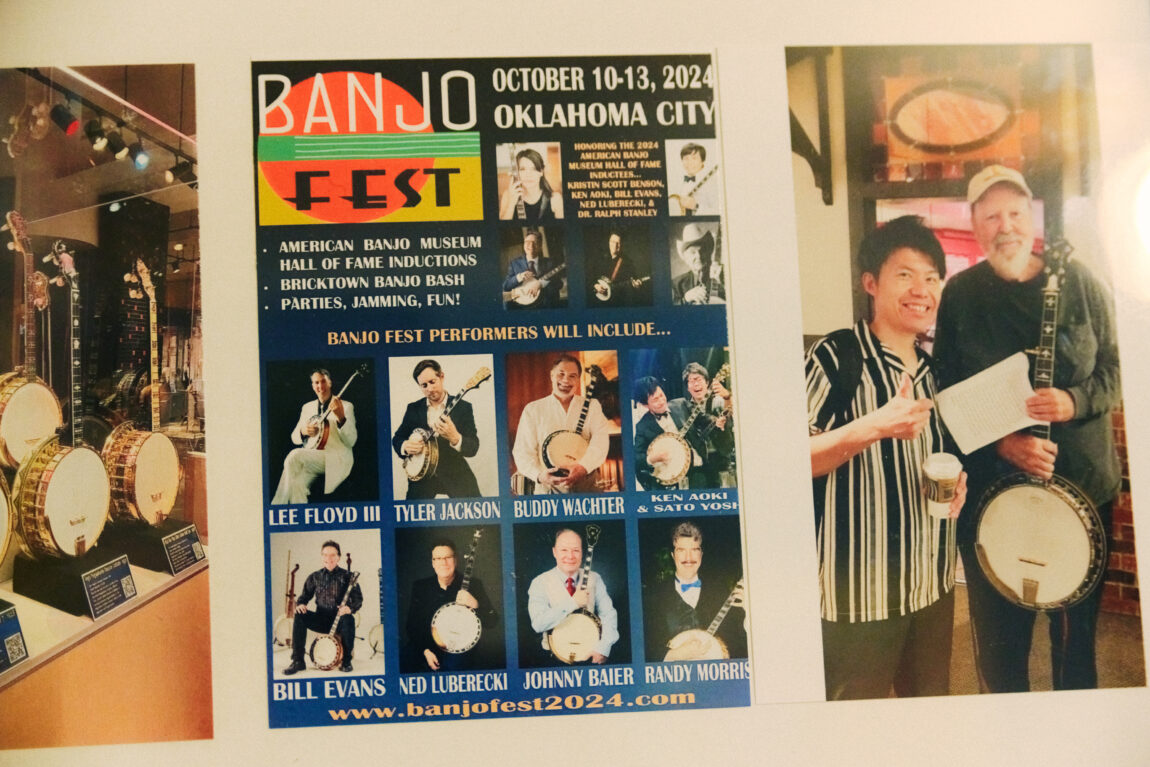
Professional banjo players are rare in Japan. If I hear a banjo in a TV commercial, I can usually tell exactly who is playing. In 2024, my former teacher, Mr. Aoki, was inducted into the Banjo Hall of Fame in Oklahoma, and I had the honor of performing alongside him. While I spend much of my time performing and arranging music, I also run a music school here in Toride.
My students come to learn guitar and banjo, but also bass, drums, and music theory. So that everyone can keep learning comfortably, I don’t stick to a rigid weekly schedule; we just have sessions whenever it works for us. Being able to play and teach so freely in such a livable and welcoming environment—that is something I believe is unique to Toride.
-
Music and Beyond: Satoshi Yoshihara